Agenda-setting intelligence, analysis and advice for the global fashion community.
Agenda-setting intelligence, analysis and advice for the global fashion community.
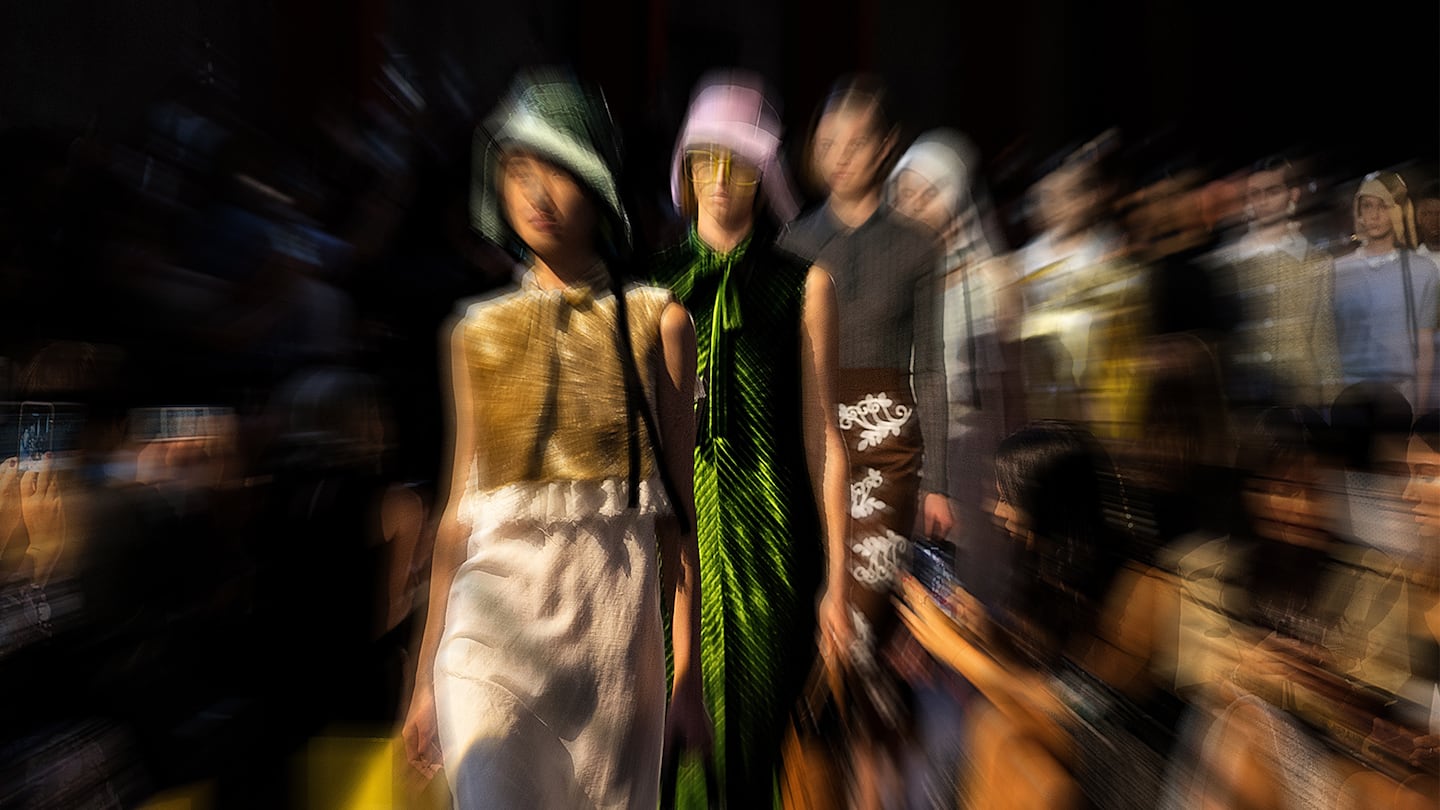
There was a time when a single fashion image could stop the industry in its tracks. Not because it went viral. Not because it was optimised for reach. But because it demanded thought.
You remember these images even if you haven’t seen them in years. The model mid-stride, caught by Richard Avedon against a white infinity, energy almost bursting out of the frame. The cool erotic charge of Helmut Newton, where power, danger and glamour coexisted uncomfortably. The quiet authority of Peter Lindbergh, whose black-and-white portraits stripped fashion of artifice and somehow made it more aspirational, not less.
These images did not ask to be liked. They asked to be looked at.
Today, fashion produces more imagery in a week than the entire industry once did in a year — and almost none of it lingers in memory beyond the next swipe. The problem is not a lack of talent. It is something more structural, and more troubling: fashion has lost the patience required to create aspiration.
ADVERTISEMENT
The great fashion photographers did not simply take pictures. They constructed worldviews. Consider Avedon’s Dovima with Elephants for Harper’s Bazaar — a couture gown placed in friction with raw animal force. Or Newton’s Le Smoking series for Vogue Paris, where the female subject is neither decorative nor reassuring. Or Lindbergh’s 1988 Vogue Italia cover with a group of young women in white shirts and jeans — an image that arguably invented modern fashion minimalism before the term existed.
What united these images was not a look, but a condition: time.
Time to conceive, to edit, to argue with editors, to fail, to refine. Time for images to circulate slowly enough to be debated, criticised, absorbed. Time for meaning to accrue.
Fashion imagery once assumed an intelligent viewer. It trusted the audience to decode references, tolerate ambiguity, even feel unsettled. Aspiration was not immediate gratification; it was something you grew into.
Today, imagery is produced at industrial scale and consumed in fractions of seconds. The feed does not reward singularity — it rewards familiarity. Images must announce themselves instantly or disappear. The result is a visual culture that is technically proficient, relentlessly polished — and profoundly forgettable.
The industry often mistakes this for democratisation. In reality, it is standardisation.
At the same moment as imagery was accelerating, fashion journalism was thinning out. There was a time when fashion writing was a genuine form of cultural criticism. Writers such as Amy Spindler understood that clothes were not merely products but signals — of politics, of gender, of power. Her reporting on designers like Alexander McQueen or Miuccia Prada did more than simply review collections; it contextualised them within a shifting social landscape. She assumed fashion mattered because culture mattered.
Similarly, Hilton Als wrote about fashion as a lens through which identity, race, sexuality and desire could be examined. His essays resisted easy conclusions. They required rereading. They treated fashion as something worthy of intellectual seriousness.
ADVERTISEMENT
Fast-forward to today, and much of fashion coverage has become a hybrid of press release, shopping guide and hot take. The dominant question is no longer what does this mean, but how fast can we publish?
There are exceptions. Tim Blanks continues to write reports that are historically informed and emotionally literate, drawing lines between designers, decades and disciplines. Cathy Horyn remains unafraid of critical distance, scepticism or dissent, qualities now treated as liabilities rather than assets.
But they are exceptions that prove the rule. The system no longer incentivises depth. It tolerates it at best.
It is tempting to blame social media in general terms, but that is too vague — and too forgiving. The economics of social media and the algorithms that underpin it reward speed, frequency and recognisability. Editorial judgement has been replaced by performance metrics. What travels fastest wins, regardless of whether it adds anything to the conversation.
This has consequences. Photographers are pressured to produce endlessly, leaving little room for experimentation or failure. Writers are asked to compress complex ideas into headlines optimised for clicks. Editors spend more time monitoring dashboards than shaping points of view.
The industry insists this is simply the price of relevance. But relevance to what, exactly? Fashion once shaped desire. Today it largely reacts to it, chasing trends it helped flatten in the first place.
Food culture offers a useful parallel. Slow food did not emerge because people forgot how to cook. It emerged because industrialised speed had stripped food of origin, ritual and meaning. The response was not nostalgia, but intention: fewer ingredients, clearer provenance, respect for time. Fashion has had no equivalent reckoning.
Instead of asking what is lost when everything is immediate, the industry has doubled down on acceleration. More drops. More content. Less memory. But imagine a slower fashion culture: fewer images, but ones that withstand scrutiny. Editors empowered to say no; creatives allowed to take risks on work that may not perform instantly. Not anti-technology but pro-meaning.
ADVERTISEMENT
This is about strategy as much as aesthetics.
Amid a flood of imagery, brands struggle to build long-term equity. Audiences lose the ability to distinguish between what matters and what merely circulates. Fashion’s role as a cultural interpreter starts to break down, leaving behind a glossy but shallow industry.
Most damaging of all, aspiration itself becomes incoherent. When everything is visible, nothing feels distant enough to desire. The industry likes to frame this as progress. In reality, it is a narrowing of ambition. The uncomfortable question is not whether fashion can still produce another Avedon or Lindbergh. It is whether it would recognise one if it did. Or whether the image would simply be scrolled past, its complexity deemed inefficient.
Fashion didn’t lose its great image-makers and thinkers. It dismantled the conditions that allowed them to matter. In an industry obsessed with what’s next, the idea that progress sometimes requires slowing down enough to think, and look, may be the most radical of all.
Robert Triefus is president and chief executive of Stone Island. Previously, he was executive vice president, corporate and brand strategy, at Gucci.
The rise of social media algorithms that endlessly select and serve up digital content — whatever triggers a dopamine buzz in our brains — has rewired the luxury fashion industry. Is feeding the feed good for business?
The polarising actress has become one of the most frequently tapped brand ambassadors in Hollywood. Whether she has the sway to build a lasting venture with her new lingerie line Syrn is still to be determined.
As fashion continues to tap into hip-hop for celeb marketing opportunities, it is searching for fresh faces beyond the same superstar partnerships.
BoF Insights’ Brand Pulse tracking tool reveals how the industry’s top-performing contemporary and accessible luxury brands cultivated loyal online communities through sharp digital engagement strategies.
A platform historically known as a destination for visual inspiration, Pinterest has been building out its shopping and advertising features to make it easier for brands to tap the power of its ready-to-shop user base.
Thom Browne, Abercrombie & Fitch and Tecovas are among the brands with Super Bowl activations. Meanwhile, the Winter Olympics kick off in Milan.
The embattled luxury department store is ‘absolutely dependent’ on companies like Chanel, LVMH and Kering, who could ‘suffocate’ the retailer if they stopped shipping, Reuters reported.
The polarising actress has become one of the most frequently tapped brand ambassadors in Hollywood. Whether she has the sway to build a lasting venture with her new lingerie line Syrn is still to be determined.
Fresh off a week of major moments, Tim Blanks and Imran Amed break down the blockbuster couture debuts at Dior and Chanel and what they signify about the state of the luxury industry.