Agenda-setting intelligence, analysis and advice for the global fashion community.
Agenda-setting intelligence, analysis and advice for the global fashion community.
When Canadian footwear brand Maguire was preparing to open its first US store in New York in 2022, its first thought to get the word out was the obvious one — target consumers based in the city through Meta ads. That is, until they saw the cost.
The brand decided to divert its spend to other platforms, including Pinterest. Quickly, it found Pinterest drew in shoppers with significantly higher purchase intent than Meta. Even after the store opening, it kept investing, increasing its ad spend on the platform by 77 percent between 2022 and 2025. In that same period, Maguire’s sales generated on Pinterest increased by 86 percent. Today, Pinterest is the brand’s top-performing paid marketing channel in the US, with a 5.59 percent conversion rate compared to Meta’s 1.72 percent.
“It’s still not crowded like Meta,” said Maguire co-founder and designer Myriam Belzile-Maguire. “Even if you don’t have the most complex strategy and you have a limited budget, it’s still worth investing.”
Pinterest has historically been seen as a destination for inspiration, not shopping. Users curate moodboards filled with photos of sleek weddings, stylised interiors and effortlessly chic outfits, which they then refer back to when making purchases elsewhere.
ADVERTISEMENT
“It was this experience of walking the bazaar, but all the stores were closed,” said vice president of product marketing and operations for Pinterest, Julie Towns.
Lately, the platform has been finding ways to open those stores for business. Since late 2024, Pinterest has rolled out several new advertising and shopping tools for brands, including its AI-driven Performance+ ad automation solution, “top of search” ads that enhance visibility and “where to buy” links, designed to help CPG advertisers drive sales while being able to easily track which ads drove sales across third-party retailers.
The idea is to both make it easier for brands to target the right shoppers and for said shoppers to find the items they want to buy on Pinterest, which is key on a platform where half of users have the intention of making a purchase, according to Pinterest. The updates have been paying off: In the third quarter of 2022, Pinterest’s business was evenly split between driving awareness, consideration and conversion, while in the third quarter of 2025, two-thirds of its revenue came from driving sales.
Success on Pinterest, however, requires a different approach than a campaign on Instagram or TikTok. Users are typically either actively seeking inspiration or in planning mode, versus passively browsing. Building out their own boards also means they’re more actively engaged with the platform.
“People get to be a little bit more creative,” said Michael Toccin, co-founder of womenswear brand Toccin. “There’s a learn and play at Pinterest, where Instagram’s more just learn.”
To use the platform effectively in marketing, the key is understanding what a brand’s target customer base uses Pinterest for and where that sits in the customer journey, and knowing how to cater to that through targeted ads and curated organic content alike.
On Pinterest, users, more often than not, know exactly what they are looking for.
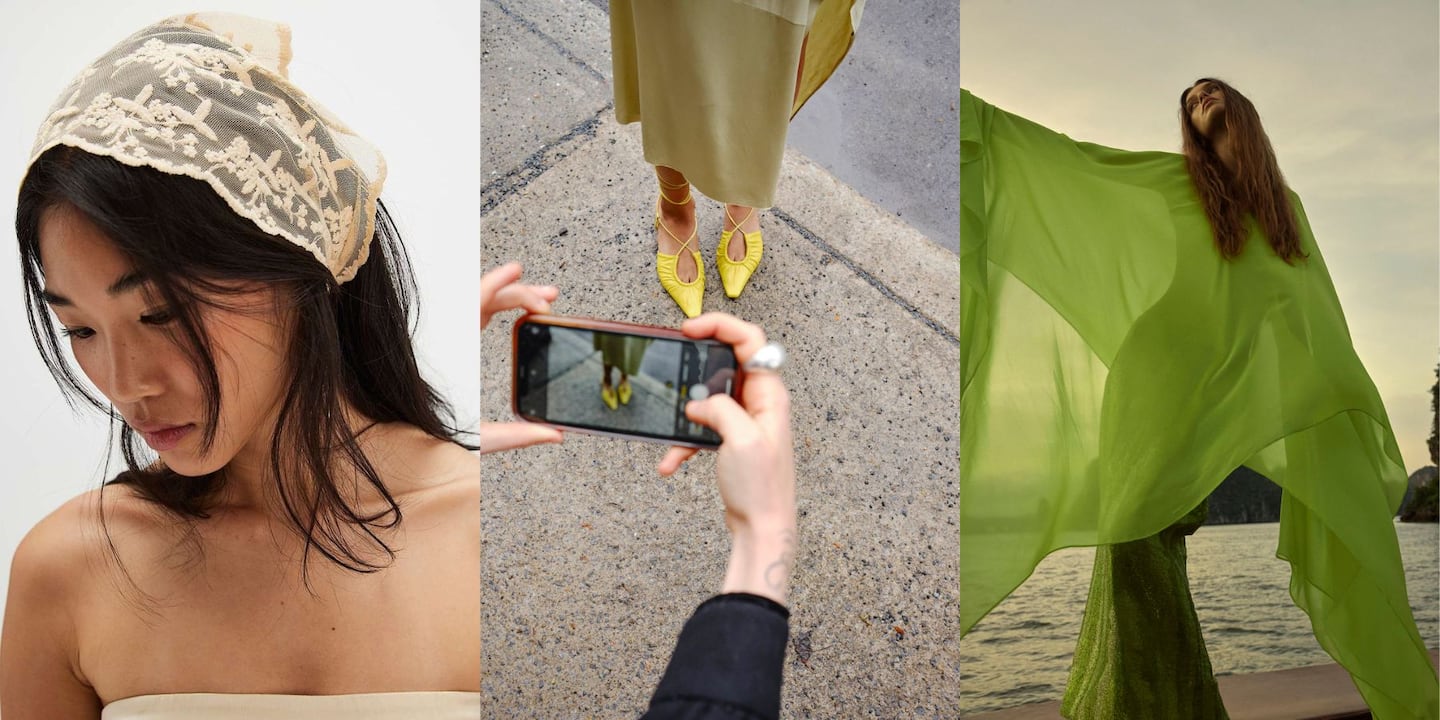
Because they usually arrive with a specific goal in mind, Pinterest users search for more niche terms than they might on other platforms, whether it’s “Juliet cap” or “lace bandana” (which saw a 150 percent increase in searches in Pinterest’s 2026 trend report).
ADVERTISEMENT
That in turn can benefit smaller brands. Maguire, for instance, sells shoes in more unexpected colours and shapes, like orange ballet flats and ruched lace-up kitten heels. Belzile-Maguire said that the brand has observed that consumers who have a precise look in mind are more willing to take a chance on an unfamiliar brand.
On Instagram, consumers may be shown a new brand but often aren’t immediately ready to make a purchase from them, according to Belzile-Maguire. “But on Pinterest, because they’re researching something so specific, if they actually find it … they might be more willing to buy the exact thing they were looking for,” she added.
Michael Toccin referred to his customers as “planners” on Pinterest. The brand uses catalog ads — which dynamically create product ads drawing from the retailer’s full product catalogue — to target shoppers at moments when they’re more likely to purchase. That strategy, according to vice president of marketing, Jennifer Volk, helped the brand multiply its ROI on its Black Friday ad spend more than sixfold, and has shortened consumers’ time spent considering a purchase, said Volk, as well as driving conversion across platforms by priming demand for when they later encounter the brand.
“It’s not just an entertainment platform,” said Pinterest’s Towns. “People have an intent.”
With access to Pinterest’s consumer search data, brands can also better understand the trends and items their target audience is searching and saving, and curate their content accordingly.
Beauty brand Ogee, for example, came across the insight that gardening fans were likely to be interested in the brand’s organic product offering. Rather than simply targeting a wider audience that’s interested in beauty, the brand was able to target a niche consumer group that was more likely to have an affinity for their brand in particular.
“The [targeting] options you have in there are unique compared to other platforms,” said Ogee co-founder Alex Stark, citing the ability to more accurately pinpoint users’ interests based on how they use the platform. “We’ve seen some products work there that didn’t work elsewhere.”
Much like on Instagram, the moment at which a consumer happens across branded content, whether an ad or an organic pin, also influences how effective different types of creative are.
ADVERTISEMENT
For the users that are searching more broadly — think wardrobe for a trip to Ibiza — their search may be more of an instinct-led rabbit hole. Oftentimes, those searches will also surface the sort of glossy, editorial imagery that is most likely to capture attention among consumers discovering a brand for the first time. To ensure they’re reaching the right shoppers, brands equip images with specific keywords linked to the topics their target customer is looking for, or use Pinterest’s “visual search” tool, which was updated in 2025 to help decode images by components, aesthetics or vibe to enhance their searchability for relevant themes.
Meanwhile, to attract a more leaned-in customer looking to learn, repurposing user-generated educational content, such as Ogee’s content teaching users how to contour in three steps, for example, has been highly effective on Pinterest, so long as it’s tweaked with text overlay to suit the visual-first platform.
Brands employ a mix of paid and organic placement on the platform in order to pop up repeatedly in a shoppers’ journey. Australian bridal label Kyha, for instance, does both in order to stay top of mind for shoppers as they’re dreaming up their dream wedding look, according to chief commercial officer, Jack Simpson. Many of its Pinterest ads direct users to Kyha’s bridal consultation booking page, which has helped drive appointments and direct sales.
Retailers with broad, quickly evolving catalogs that can cater to niche searches also benefit from Pinterest’s ad toolkit. Secondhand retailer The RealReal, for instance, first invested in paid ads on Pinterest at the beginning of 2025, using Performance+ to surface product ads that are either an exact or lookalike match to what consumers are looking for, whether it’s a specific item, like a Chloé Paddington bag or garments that fit a certain aesthetic, such as Y2K.
Lindsay Ferstandig, senior vice president of strategy and marketing for The RealReal, said that efficiency-wise, the results are comparable to what they see when advertising on Meta. It plans to continue to scale its efforts in 2026.
“We can be reaching people in a really organic but also performant way to grow the business,” said Ferstandig.
As paid marketing on Meta gets cheaper and easier to target customers, brands are getting more strategic about the content that attracts consumers at different points in their shopping journey.
From informing shoppers at the research stage to triggering a Super Bowl campaign, Reddit is becoming a gold mine for consumer insights and conversions alike.
After a year of experimentation and noise, 2026 marks a pivot for fashion marketers toward slower advertising, more thoughtful creative risks and human connection, as brands recalibrate how to entertain, engage and earn trust in an age of AI and consumer exhaustion.

Haley Crawford is Marketing Correspondent at The Business of Fashion. She is based in New York and covers the marketing and public relations industries.
The polarising actress has become one of the most frequently tapped brand ambassadors in Hollywood. Whether she has the sway to build a lasting venture with her new lingerie line Syrn is still to be determined.
As fashion continues to tap into hip-hop for celeb marketing opportunities, it is searching for fresh faces beyond the same superstar partnerships.
An industry that manufactures images at industrial scale and speed is forgetting how to create aspiration, writes Robert Triefus.
BoF Insights’ Brand Pulse tracking tool reveals how the industry’s top-performing contemporary and accessible luxury brands cultivated loyal online communities through sharp digital engagement strategies.
Thom Browne, Abercrombie & Fitch and Tecovas are among the brands with Super Bowl activations. Meanwhile, the Winter Olympics kick off in Milan.
The embattled luxury department store is ‘absolutely dependent’ on companies like Chanel, LVMH and Kering, who could ‘suffocate’ the retailer if they stopped shipping, Reuters reported.
The polarising actress has become one of the most frequently tapped brand ambassadors in Hollywood. Whether she has the sway to build a lasting venture with her new lingerie line Syrn is still to be determined.
Fresh off a week of major moments, Tim Blanks and Imran Amed break down the blockbuster couture debuts at Dior and Chanel and what they signify about the state of the luxury industry.