Agenda-setting intelligence, analysis and advice for the global fashion community.
Agenda-setting intelligence, analysis and advice for the global fashion community.
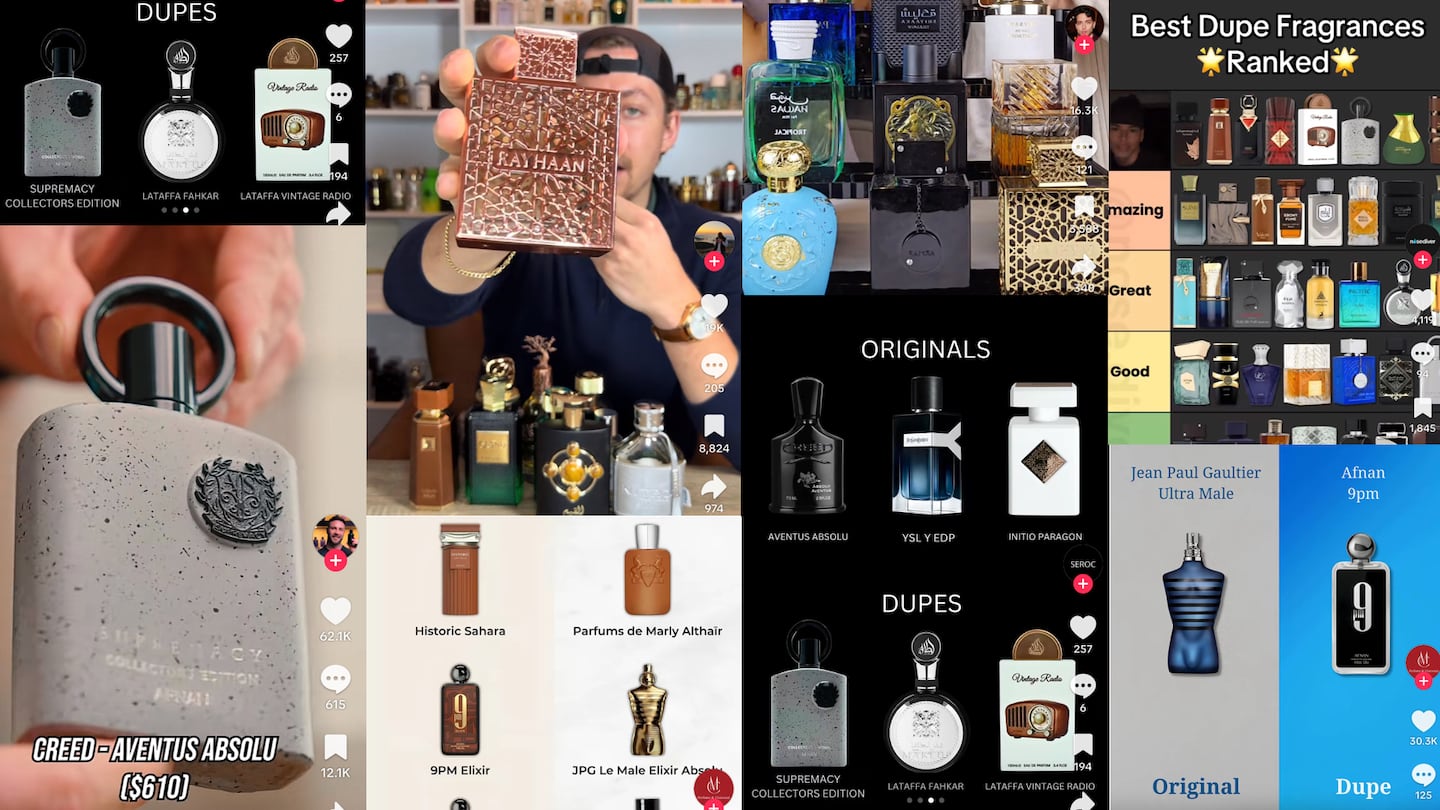
Look across any men’s fragrance collection posted to Reddit or TikTok, and you’ll see that luxury brands reign supreme. Countless photos and videos flex stockpiles of scents by brands like Parfums de Marly, Dior, Jean Paul Gaultier, Amouage and Creed. But nearly just as often, joining them on collectors’ display shelves are labels like Lattafa, Hawas and Afnan, purchased for as little as a tenth of the price of their high-end counterparts.
Known for decadent oud fragrances with prices stretching as high as $1.3 million per bottle, Dubai is undoubtedly a global luxury perfume capital. But among the #PerfumeTok community, the affluent UAE city has become a source of masstige fragrances in display-worthy bottles. A wave of Dubai fragrance brands have taken over the global affordable perfume market, ascending the list of top sellers on TikTok Shop and Amazon thanks to fascination with the city’s opulence, enthusiasm for fragrance collection, and, much to luxury brands’ chagrin, dupe culture.
“Dubai, for people, is a perception of luxury,” said Abdul Rahim Shaikh, the head of R&D at Lattafa, which has become the most popular of the Dubai masstige brands in the market and is headed into a “major” US beauty retailer “very soon,” he said. Its $25 bestseller Khamrah, an aromatic scent described by influencers as similar to Kilian’s Angels’ Share, is frequently among the top five fragrances on Amazon, while its parent company Lattafa Perfumes Industries LLC owns a portfolio of brands including Maison Alhambra and Asdaaf.
A look at Amazon’s top-selling fragrances reveals that roughly one-third of the entire list is made up of affordable UAE brands mostly from Dubai, with names like Rasasi, Armaf and Swiss Arabian, many in luxurious-looking glass bottles with gold accents. Rarely does a listing exceed $30.
ADVERTISEMENT

Dubai’s fragrance industry is rooted in the Middle East’s rich history as the birthplace of perfume and boosted by local spending power. The city’s massive malls are filled with regional luxury perfume brands, while international labels eagerly create scents to appeal to local clients. On the premium end, Mona Kattan’s Kayali has been a hit both at home and around the globe with Sephora shoppers.
But apart from Kayali, the wave of Dubai brands gaining global traction are mainly masstige. Affordable luxuries in other categories, like pistachio-filled $30 “Dubai chocolate” bars, have also taken off with a Gen Z audience.
“It’s not a high price point at all, but it feels luxurious,” said Mathilde Riba, a beauty analyst at market trends research firm Spate.
The global rise of Dubai’s fragrance industry is rooted in its position as a trade centre.
Dubai’s free-trade zone status keeps ingredient costs lower, said fragrance consultant Robert Sorce, a former executive at Creed and Byredo, who noted that local companies have better access to prized Middle Eastern fragrance oils. That’s also a factor in why global fragrance producers are flocking to the city: Givaudan opened a center there in 2024, followed by IFF, which opened its Scent Dubai Creative Center last year.
Before Lattafa took off on TikTok in mid-2025, it had already operated for decades as a family-owned fragrance brand founded by traders of ingredients like musk oil and oud, including Shaikh’s father Sheikh Shahid Ahmad.
“This region has always had a very practical relationship with fragrance,” said Renaud Salmon, the chief creative officer at Omani luxury fragrance brand Amouage. “Perfume is everyday culture here.”
Many Emirati brands are multi-generational labels getting a social media boost from young heirs, said Rami Rabia, a fragrance content creator based in Dubai.
ADVERTISEMENT
“The second and third generation … [are] getting into the business,” said Rabia. “They’re young, and they understand social media a lot more, so they’re tapping into it a lot more.”
Lattafa, for example, only launched its TikTok Shop and began working with influencers last year, said Shaikh. His team had noticed the brand gaining traction on PerfumeTok for around three years before that. According to trends market research firm Spate, Lattafa was the fourth highest growing beauty brand across all categories for 2025 with a 102.1 percent increase in popularity based on volume from Google, TikTok and Instagram searches.
But its quick lean into the platform and explosive popularity proved risky when it led to a wave of AI influencer posts linking to purchase Lattafa through third-party sellers. An AI-edited clip of the reality show Love Island depicting cast member Huda Mustafa promoting the brand during summer 2025 was confirmed in a later Allure interview to be fake. After it went viral, the brand saw a spike in sales and orders from distributors.
“I thought it was real, honestly,” said Shaikh, who said Lattafa did not have a role in the ad’s creation.
Beyond luxury branding and affordable price points, TikTok’s dupe obsession has fuelled the Dubai scent craze. Nearly every luxury fragrance with a following on the market has been compared to an Emirati brand by a perfume influencer.
“Creators are going to talk about what the market wants, or what gives them an edge online,” said Rabia. “They’ll lean into the dupes and say, ‘This smells like this.’ It becomes almost like a competition.”
Lattafa’s Maison Alhambra created a scent called “Deliah” bottled in the same powder-pink colour as Parfums de Marly’s Delina, while its Kismet scent resembles a bottle from Lauder-owned Kilian.
The scent 9 PM by Afnan, a brand produced in Ajman, UAE with offices in Dubai, is often compared to Jean Paul Gaultier’s Le Male, while its fragrance Supremacy is frequently described as a Creed Aventus knockoff.
ADVERTISEMENT
Brand representatives are quick to dispute dupe designations.
“I personally don’t appreciate the word dupe,” said Rafiq Meherali, the president of Afnan’s US office, who said that influencers were acting independently.
As with cosmetics and skincare, the greater fragrance industry is perturbed by dupes. After Amouage skipped Dubai’s Beauty World Middle East trade show in Oct. 2025, Salmon posted on his Instagram Stories that the conference’s organisers “blindly accept counterfeiters” in fragrance.
“The fair is also a platform for obvious counterfeiters and laughably close dupes of established luxury houses,” said Salmon. “These practices are not secret.”
Currently sold through Amazon and TikTok Shop in the US, Lattafa’s pending entry into a yet-to-be-named retailer will be a first test of Dubai masstige fragrance’s staying power. The proof will be in its repurchase rates. In the meantime, the brand is working to shed its dupe image.
“We don’t like to be situated with that category of fragrances. We want to be different,” Shaikh said. As for some influencers’ interpretations of similarities, he disagreed. “Khamrah doesn’t smell like Angels’ Share,” he said of the brand’s top seller. “I think it smells better than Angels’ Share.”
Want to dive deeper into an insight from this article? Check out The Brain of Fashion, BoF’s new generative AI tool where you can unlock BoF’s beauty archive with a single question.
Sign up to The Business of Beauty newsletter, your complimentary, must-read source for the day’s most important beauty and wellness news and analysis.
From Chanel to Kayali, beauty brands at every price point are eschewing ‘signature scent’ marketing in favour of creating a wardrobe of perfume options.
Last week, Zegna staged a runway show in Dubai the emirate, following in the footsteps of Roberto Cavalli, Armani and Chanel. The emirate remains the most established hub for luxury shopping in the Gulf region, which has bucked the industry’s downward trend.
Saie, Kosas, Ilia and Glossier are among the beauty brands launching at Sephora Middle East this fall as the GCC countries become a priority for global expansion.
Liz Flora is a Beauty Correspondent at Business of Fashion. She is based in Los Angeles and covers beauty and wellness.
Brands are designing products and packaging meant to be clicked, tapped and touched. Actually using them is beside the point.
This week, I look at the very different roads traveled by Pat McGrath and Charlotte Tilbury, wait with bated breath for Pleasing’s comeback and review LVMH’s beauty results.
European shoppers are increasingly buying beauty online, but local merchants face stiff competition from newer giants like Amazon and TikTok Shop.
As discovery commerce reshapes the beauty industry, this playbook details how brands can leverage modern shopping behaviours, boost awareness and build cross-channel demand through TikTok Shop’s creator-led marketplace — with insights from Phlur, Medicube and POV Beauty’s Mikayla Nogueira.
The embattled luxury department store is ‘absolutely dependent’ on companies like Chanel, LVMH and Kering, who could ‘suffocate’ the retailer if they stopped shipping, Reuters reported.
The polarising actress has become one of the most frequently tapped brand ambassadors in Hollywood. Whether she has the sway to build a lasting venture with her new lingerie line Syrn is still to be determined.
Fresh off a week of major moments, Tim Blanks and Imran Amed break down the blockbuster couture debuts at Dior and Chanel and what they signify about the state of the luxury industry.
Since the audit began in 2020, the Milanese fashion group found that more than a quarter of suppliers and subcontractors inspected had broken compliance rules.