Agenda-setting intelligence, analysis and advice for the global fashion community.
Agenda-setting intelligence, analysis and advice for the global fashion community.
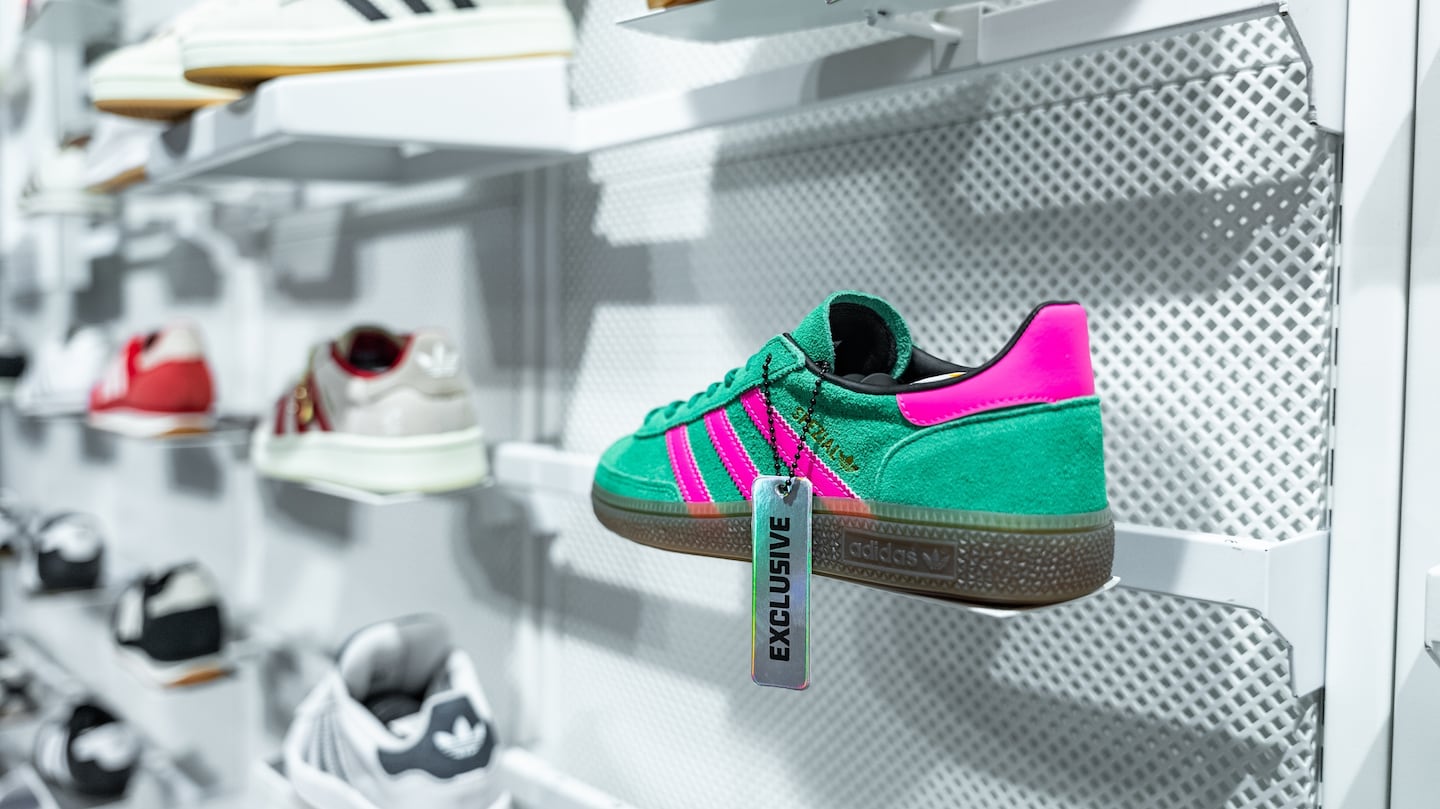
Conversations about the sneaker business are always driven by which has the most heat. Is it Nike or Adidas? On or Hoka? Maybe Puma or Asics is catching on.
But what if this time the answer is: none of the above?
That’s the premise of a report last week by Bank of America, which accompanied a rare double-downgrade of Adidas, the “it” brand of the moment thanks to its top-selling Sambas, from “buy” to “underperform.” Over 61 pages, analyst Thierry Cota outlined how recent signs of slowing Samba sales are the tip of the iceberg. He predicted that sneakers’ multi-decade rally, which saw the shoes migrate from the basketball court to everyday life and even the office, had run its course.
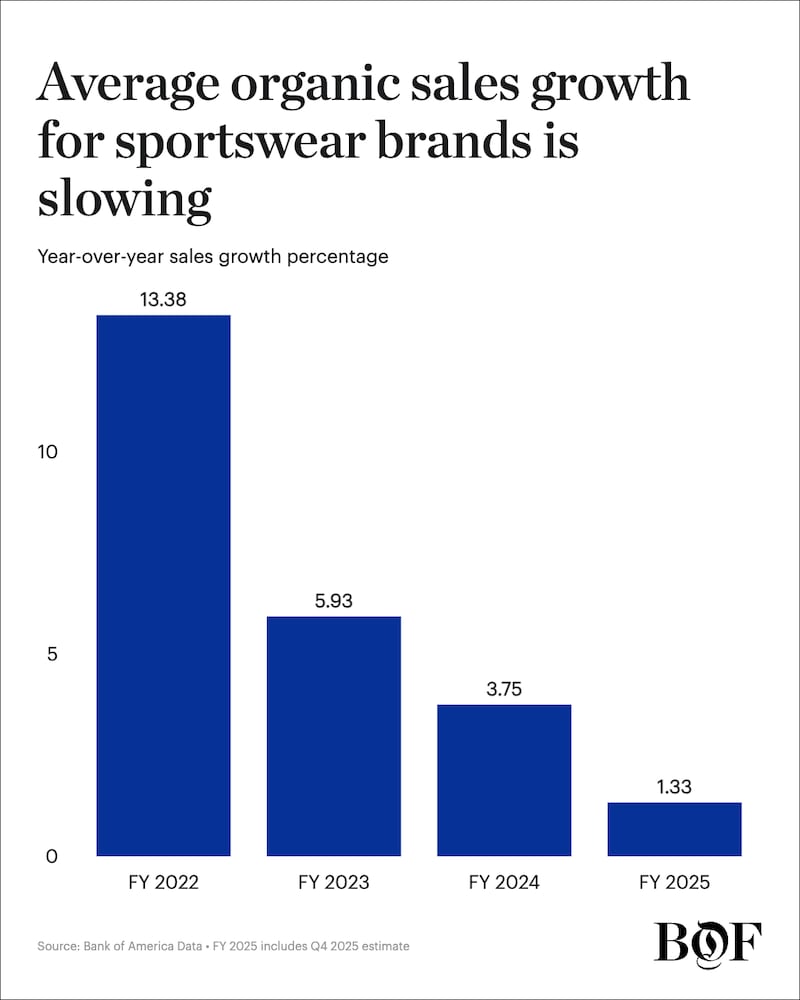
“We now believe that the ongoing downcycle is only the short-term reflection of a long-term slowdown,” the report said, noting that sportswear sales growth has slowed for three straight years, rising a mere 1.3 percent in 2025.
ADVERTISEMENT
The report sent shockwaves through the sneaker industry, where pessimism is vanishingly rare. Sneaker sales have been on a 20-year upswing, migrating from the basketball court to everyday life and even the office, accounting for nearly 60 percent of all footwear sales, according to market data firm Circana. To get a sense of how out of step Bank of America is with the consensus, the bank joins one other analyst in recommending clients sell Adidas; 27 have buy ratings on the company’s stock, according to Bloomberg.
The numbers don’t lie: sportswear sales are slowing, and sneakers with them. But is Bank of America correct in calling an end to the “casualisation” trend that’s driven consumers to trade out their heels and loafers for sneakers, year after year, for decades?
“I’m not seeing anything close to that,” said Matt Powell, a senior advisor at BCE Consulting.
Who turns out to be right has major implications for the fashion industry as a whole. In an expanding market, Nike and Adidas can execute turnarounds alongside fast-growing challengers like On and Hoka. If overall sales have plateaued, every extra dollar spent at Nike comes at the expense of one of its rivals.
There’s no question that the sneaker industry has seen unprecedented growth for a nearly unprecedented length of time. Sneakers have become the strongest segment in the footwear retail industry, accounting for nearly 60 percent of sales when both athleisure and performance sneakers are included, according to Circana data.
The sneaker market reached about $50 billion in 2025 in the US alone, per Circana. When a sector gets that large, growth naturally slows.
“It really isn’t realistic to keep up triple-digit growth rates, high double-digit growth rates, year after year after year,” said Beth Goldstein, Circana’s executive director and industry analyst for footwear and accessories.
Consumers have opted for more comfortable clothing over the last few decades as streetwear and sportswear have entered fashion’s mainstream. For most of this era, Nike led the charge, though more recently, Adidas has been the hotter company between the two. The sporty yet sophisticated Samba caught fire in 2023 as Adidas began to lean more on its foundational styles following the fallout from Yeezy. Around the same time, Nike began to cool off as it leaned too heavily on retro styles.
ADVERTISEMENT
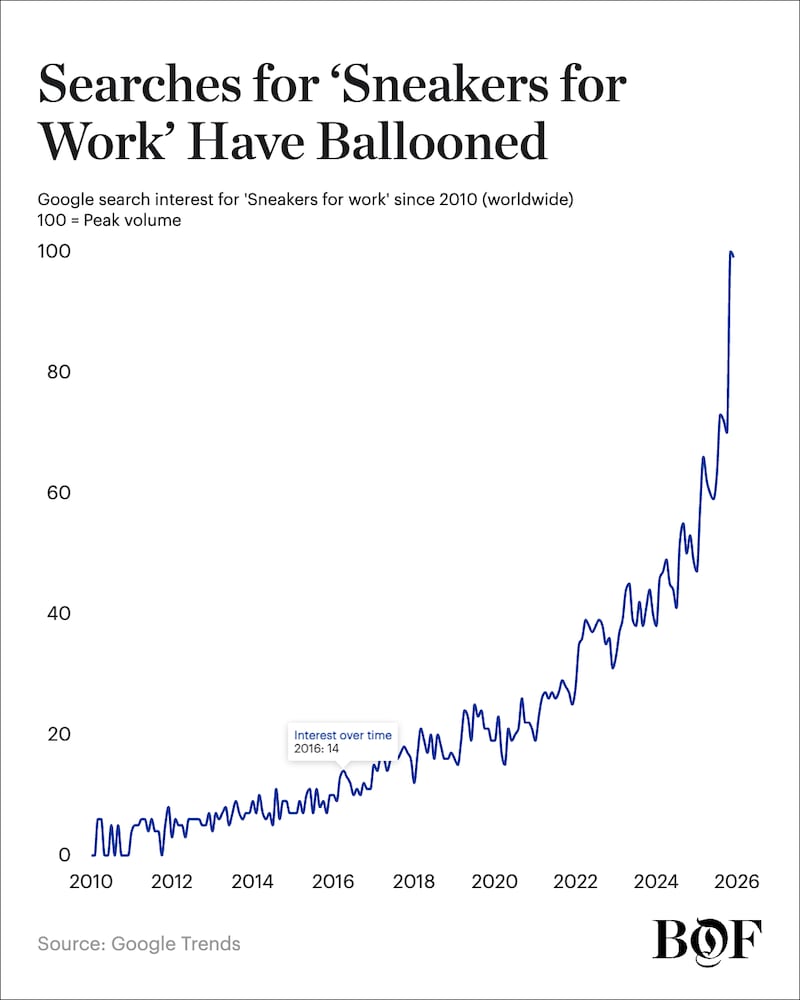
It’s hard in the moment to separate the natural turning of the fashion cycle from the end of an era. The concept of “sneakers for work” or “office sneakers” is one example of the latter: Google searches for the idea were practically nonexistent until the early 2010s, and didn’t truly begin to rise until the latter half of the decade.
Even when a trend is on the way out, it can take years; the death of skinny jeans was predicted many times before wide-leg trousers finally took hold.
While the idea that the trend towards more casual dressing could reverse feels farfetched today, it’s not without historic precedent, according to Elizabeth Semmelhack, the director and senior curator of Toronto’s Bata Shoe Museum.
“In the 1920s, after the pandemic and after World War One, it was the roaring 20s,” Semmelhack said. “[Then], clothing changed so dramatically, and everything really becomes much more about dressing up.”
Powell described the current deceleration for sneakers as a climbdown from the “free money” days of the pandemic, when work-from-home mandates led many consumers to trade in their dress shoes and heels for good. But the more moderate growth of the last couple years is not far off from the industry’s pre-Covid trendline.
“Typically, in the last 25 years that I’ve been doing this, athletic shoes grow between three and five percent a year,” he said. “Maybe we’re a little below that, but there’s no sign that people are turning away from sneakers.”
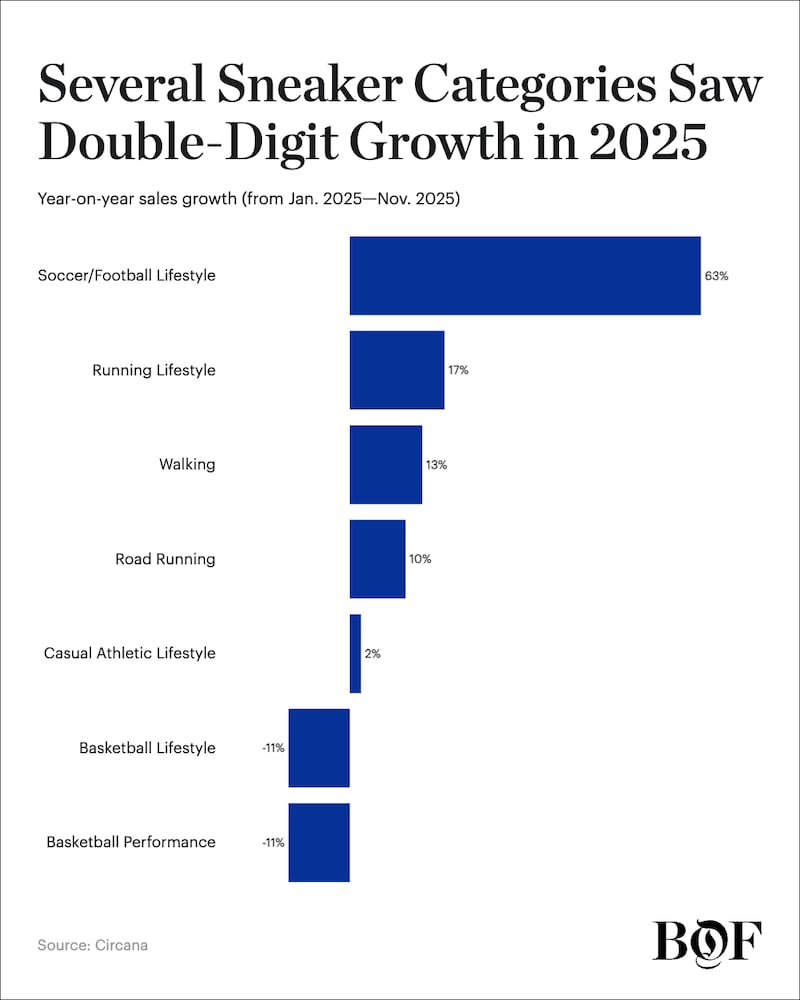
Meanwhile, sneaker styles continue to perform well, according to Circana’s data. Even as certain styles show signs of slowing down, others, like running, are waiting in the wings to drive growth.
There are also opportunities for growth on the horizon. While Bank of America only expects a moderate boost for Nike and Adidas from the 2026 FIFA World Cup, both companies seem to anticipate the event providing them with a second wind. They’ve already launched multiple products and partnerships in anticipation of the competition.
ADVERTISEMENT
Semmelhack would be more convinced that the end is near for sneakers if there were something credible in the market to replace them, but as it stands, there doesn’t seem to be.
“I just don’t see the thing that’s replacing it,” she said. “Nothing’s coming in. I don’t yet see the next “It” thing.”
Goldstein agreed. Circana data showed that performance and athleisure footwear sales are up nearly 4 percent year-to-date in dollar sales, while the fashion segment declined 3 percent. A trend shift would feel more realistic if there were other styles were there to replace sneakers, but nothing has quite risen to the top yet.
“Some of the things like loafers or ballet flats and this past fall, the high shaft boot for women, have been really strong,” Goldstein said. “But these are in the grand scheme of things, they’re small pieces of the market.”
With that said, Semmelhack, the companies that have been relying on sneakers for all these years shouldn’t rest on their laurels. Maybe the growth slowdown doesn’t mark the end, but it does signal something is missing. While these companies are massive, she said, none of them is too big to fail.
“I think they could. 100 percent,” she said.
Want to dive deeper into an insight from this article? Check out The Brain of Fashion, BoF’s new generative AI tool where you can unlock BoF’s sports archive with a single question.
The Business of Fashion crunched the numbers, polled readers and spoke with leading sneaker authorities to identify the shoes that defined the market this year – and pointed the way to what’s coming next.
The sneaker aftermarket and sneaker culture might not be where they were during their peak years in the early 2020s, but that doesn’t mean that it’s over.
A wave of new performance basketball sneakers featuring fresh designs has shoppers once again considering the category for fashion and not just for wear on the court.

Mike Sykes is the Sports and Fashion Correspondent at the Business of Fashion. He is based in Washington, D.C. and is laser-focused on covering the sportswear world where it intersects with fashion, tech and more.
Adidas’ staggering growth continues while the rest of the sportswear industry struggles to find its footing.
The activewear company’s dilemma is familiar to many companies that have grown rapidly and need to find ways to keep expanding while competitors encroach.
After months of speculation, Anta has finally acquired the Pinault family’s 29 percent stake in Puma. Suddenly, the brand’s future doesn’t seem so bleak.
The Yeezy founder and rapper also apologised to the Black community after suggesting in 2018 that slavery was ‘a choice.’
The embattled luxury department store is ‘absolutely dependent’ on companies like Chanel, LVMH and Kering, who could ‘suffocate’ the retailer if they stopped shipping, Reuters reported.
The polarising actress has become one of the most frequently tapped brand ambassadors in Hollywood. Whether she has the sway to build a lasting venture with her new lingerie line Syrn is still to be determined.
Fresh off a week of major moments, Tim Blanks and Imran Amed break down the blockbuster couture debuts at Dior and Chanel and what they signify about the state of the luxury industry.
Since the audit began in 2020, the Milanese fashion group found that more than a quarter of suppliers and subcontractors inspected had broken compliance rules.